


Buyer reference tool
Stainless Steel Grade and Finish Selection Reference
Grade and finish should be selected as one purchasing decision because corrosion exposure, forming, welding, appearance, cleanability, and inspection all act on the delivered surface. Use this reference to prepare a shortlist, then confirm the governing product standard and the finished-part requirements with the responsible engineer.
SSR reference
Start with the published comparison
| Selection question | Typical option to review | Evidence to request |
|---|---|---|
| Cost-sensitive formed parts in mild, controlled service | 201 / UNS S20100 | ASTM A240 or the governing standard, chemistry, formability requirements, and approved sample |
| General atmospheric or controlled process exposure | 304 / UNS S30400 or 304L / UNS S30403 | Standard, chemistry, mechanical properties, form, finish, and welding route |
| Chloride-bearing or more aggressive wet service | 316 / UNS S31600 or 316L / UNS S31603, then higher alloy if needed | Service data, corrosion review, chemistry, and PMI when specified |
| Dry indoor trim, appliances, or mildly corrosive service | 430 / UNS S43000 | Forming duty, weld expectations, surface acceptance, and governing product standard |
| Higher-strength chloride service requiring duplex review | 2205, commonly UNS S32205 or S31803 | Specified UNS designation, heat treatment, corrosion basis, mechanical requirements, and PMI |
| Severe acid or high-alloy process duty requiring specialist review | 904L / UNS N08904 | Detailed process chemistry, temperature, corrosion assessment, product standard, and PMI |
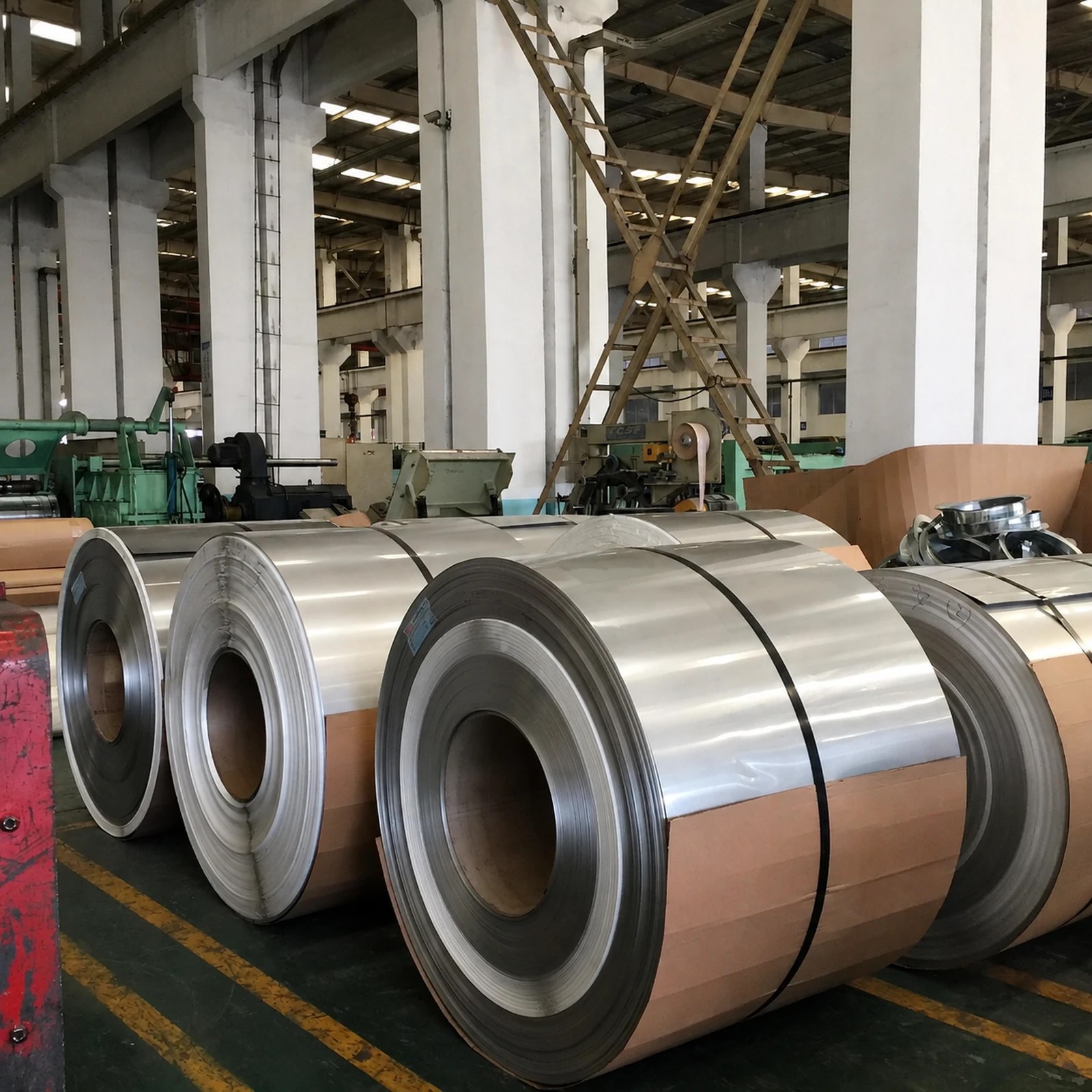
| Cold-rolled flat product for fabrication | 2B, BA, or agreed polished finish | Finish designation, sample, roughness when relevant, film, and defect limits |
| Hot-rolled plate for heavier fabrication | No. 1 or agreed descaled condition | Thickness tolerance, flatness, surface class, weld route, and inspection document |
Selection logic
- 1.Start with corrosion and temperature exposure, then remove grade families that lack a defensible service history or engineering basis for the stated conditions.
- 2.Match the product form and delivery condition to forming, welding, machining, dimensional tolerance, and mechanical-property needs.
- 3.Define the finish by measurable or sample-based acceptance criteria. Keep appearance, roughness, cleanability, and post-weld restoration as separate checks.
- 4.Confirm the final designation against one product standard and list any required inspection document, PMI, surface, or dimensional records.
Limits
- The table is a shortlist aid and does not calculate corrosion allowance, service life, pressure design, regulatory compliance, or finished-equipment hygiene.
- Grade names, finish labels, and cross-standard comparisons require review against the cited standard revision and the actual product form.
- UNS S32205 and S31803 overlap in common 2205 procurement language but are not automatically interchangeable; the order must state the required UNS designation and governing specification.
Error recovery
- If the medium or chloride level is unknown, keep the result open and request service data before choosing between 304L, 316L, or a more highly alloyed grade.
- If a finish cannot be described with a standard, roughness, direction, or sample, request an approved sample and define repair-area acceptance before ordering.
- If the proposed grade comes from another standard system, compare chemistry, mechanical requirements, heat treatment, dimensions, and test rules before substitution.
Continue with application and product owners
Food processing selection
Apply grade and finish questions to food-contact equipment and cleaning cycles.
Open owner201 stainless steel coil
Review a manganese-bearing austenitic coil option for controlled service and fabrication requirements.
Open owner304L stainless steel plate
Review one common low-carbon austenitic plate owner.
Open owner316L stainless steel plate
Review a molybdenum-bearing plate owner for assessed service conditions.
Open owner430 stainless steel coil
Review a ferritic coil option with forming, welding, and finish requirements kept explicit.
Open owner2205 duplex stainless steel plate
Review a duplex plate owner while preserving the specified UNS designation and heat-treatment requirements.
Open ownerRFQ requirements
Use the selector with these remaining commercial and technical fields.
- 01
Service medium and contaminants
- 02
Temperature and exposure cycle
- 03
Standard, grade, and product form
- 04
Dimensions, tolerance, finish, and fabrication route
- 05
Inspection documents, quantity, packing, and destination
Frequently asked questions
Can this guide confirm an exact stainless steel grade?
It can organize the questions and narrow the options. Exact selection still needs the stated service, product standard, design duties, fabrication route, and responsible technical review.
Are 2B, BA, and No. 4 interchangeable finish names?
They describe different production or polishing conditions. Acceptance should cite the applicable standard or sample and include direction, roughness when relevant, film, and repair rules.
Can a grade from one standard replace a similar grade from another?
Only after a documented comparison of chemistry, mechanical requirements, delivery condition, dimensions, tests, and the project specification. Similar naming is not sufficient evidence.