


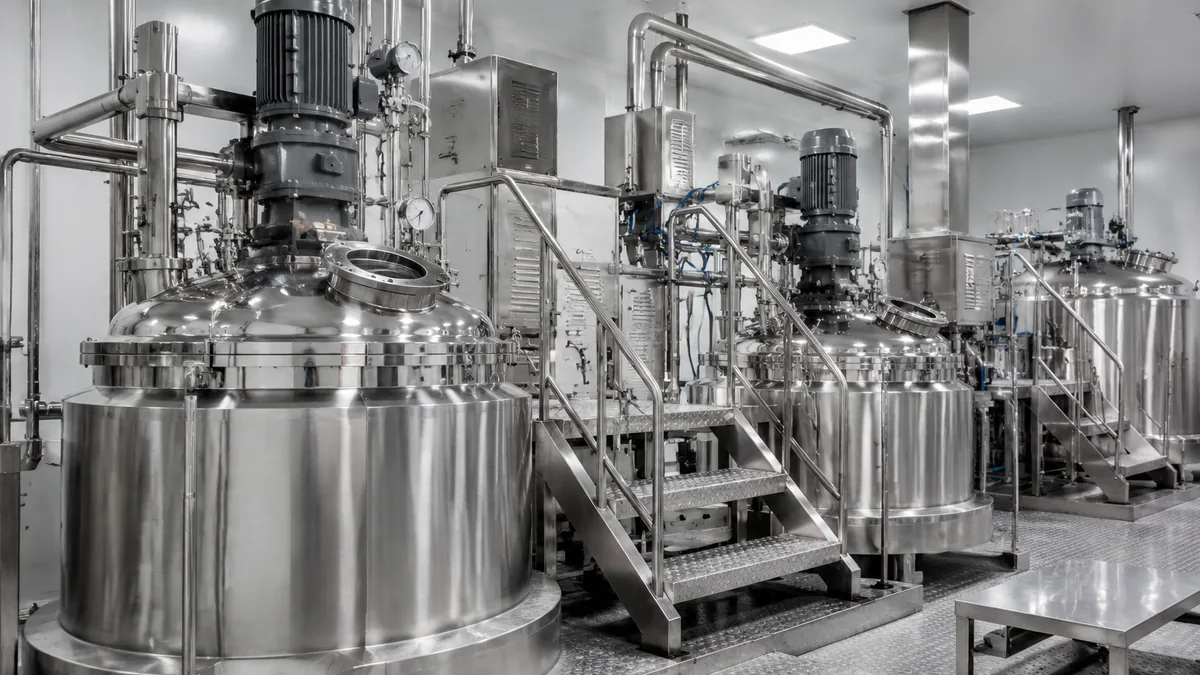
Application selection brief
Stainless Steel Selection for Food Processing Equipment
A useful food-equipment specification starts with the material contact conditions and the cleaning cycle. Product acidity, chlorides, temperature, dwell time, crevices, weld access, and cleaning chemicals can change the corrosion risk. The grade, product form, finish, weld treatment, and acceptance documents should therefore be stated together in the RFQ.
Selection inputs
Service conditions to define
- Direct or indirect food contact, including the product chemistry, contact time, operating temperature, and whether the equipment drains fully.
- Cleaning and sanitation cycles, including chemical concentration, temperature, frequency, rinse quality, and the possibility of trapped solution.
- External exposure around washdown zones, coastal air, insulation, supports, fasteners, and mixed-metal joints where crevices can retain moisture.
- Fabrication route, including forming severity, weld process, access for finishing, and the surface condition required after fabrication.
Failure review
Risks the specification must address
- Pitting or crevice corrosion can begin where chlorides concentrate, deposits remain, or gaskets and joints create shielded areas.
- Heat tint, embedded iron, rough weld transitions, and poorly restored surfaces can make cleaning harder and reduce local corrosion resistance.
- A finish name alone can hide meaningful differences in roughness, direction, repair method, and the final condition after welding or forming.
- Grade substitution without a reviewed chemistry, standard, and service comparison can create an undocumented change in corrosion or fabrication behavior.
Procurement matrix
Compare the service, material route, and evidence
| Service condition | Common starting point | RFQ checks |
|---|---|---|
| General food contact with controlled cleaning and low chloride exposure | 304 or 304L sheet, plate, coil, tube, or bar as the design requires | Product chemistry, cleaning chemicals, finish, weld treatment, and material certificate |
| Higher chloride exposure, salty products, aggressive cleaning, or persistent wet crevices | 316 or 316L is often reviewed before more highly alloyed options | Chloride level, temperature, dwell time, crevice detail, and corrosion review |
| Formed panels, tanks, hoppers, guards, and fabricated assemblies | Sheet or plate with temper, flatness, finish protection, and weldability stated | Thickness, tolerances, grain direction, forming radius, finish film, and cut plan |
| Decorative external surfaces away from the product-contact zone | 2B, BA, brushed, or other agreed appearance reference | Approved sample, viewing direction, roughness when relevant, and repair acceptance |
Acceptance package
Standards, inspection, and fabrication
Standards and inspection
- Name the applicable product standard and grade designation for each form. Similar grade names from different systems require a documented comparison before substitution.
- State the inspection document required, such as an EN 10204 3.1 certificate when applicable, and identify any chemistry, mechanical, PMI, or surface records needed.
- Define finish acceptance with a standard designation, directional requirement, roughness value when relevant, protected sample, and rules for weld or repair areas.
- Separate base-material certification from finished-equipment hygiene, pressure, welding, and regulatory acceptance.
Fabrication controls
- Record forming direction, minimum bend radius, weld procedure needs, filler selection responsibility, and the post-weld cleaning or surface-restoration requirement.
- Protect finished sheet from carbon-steel contamination during storage and fabrication, and agree how scratches, heat tint, embedded iron, and protective film are handled.
- Confirm whether laser film, paper interleave, edge condition, blanking, or cut-to-size supply is compatible with the planned process.
Continue with the registered product owners
304L stainless steel plate
Review a common low-carbon 304 plate starting point for fabricated food equipment.
Open owner316L stainless steel plate
Review a molybdenum-bearing option when the service corrosion assessment requires it.
Open ownerGrade and finish selection guide
Compare service questions, product forms, finishes, and RFQ evidence in one reference.
Open ownerOrder-ready data
RFQ requirements
Send these fields together so technical review starts from one consistent specification.
Prepare an RFQ- 01
Product or process medium, chloride or salt exposure, contact time, and operating temperature
- 02
Cleaning chemicals, concentration, temperature, frequency, rinse condition, and washdown exposure
- 03
Required grade, product standard, form, thickness, dimensions, tolerances, and quantity
- 04
Surface finish, roughness or sample requirement, protective film, weld condition, and edge condition
- 05
Inspection certificate, PMI or testing needs, packing limits, destination port, and requested delivery window
Frequently asked questions
Is 316L required for every food processing application?
No single grade fits every process. 304L is widely considered for controlled food-contact service, while 316L is often reviewed when chlorides, salty products, aggressive cleaning, heat, or persistent crevices increase corrosion risk. The final choice needs the actual service data.
Does a 2B or No. 4 finish prove that a surface is hygienic?
A finish designation describes part of the supplied surface condition. Hygienic acceptance can also depend on roughness, direction, weld finishing, drainage, cleanability, contamination control, and the finished equipment standard.
What should be included in a food equipment stainless steel RFQ?
Include the medium, temperature, cleaning cycle, chloride exposure, standard and grade, form and dimensions, finish acceptance, fabrication route, inspection documents, packing, quantity, and destination.