









Introduction
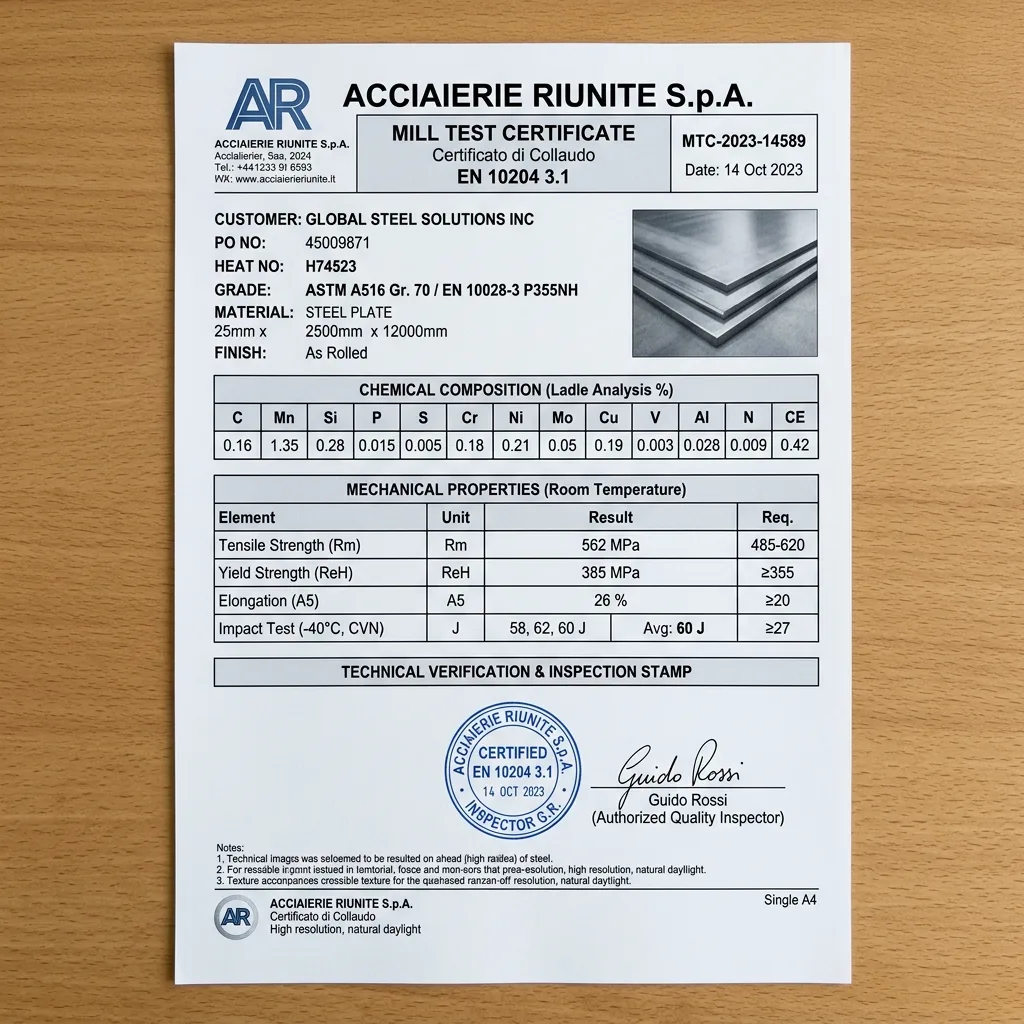
A steel Mill Test Certificate, often called an MTC or MTR, is not just a document for the file. For importers, it is the link between the purchase order, the supplied steel, the heat number, and the quality evidence needed before shipment release.
The safest time to review the MTC is before loading, not after the container reaches the destination port. If the certificate type, heat number, grade, quantity, or test data does not match the order, fixing the problem after shipment is slower, more expensive, and harder to document.
What A Steel MTC Should Prove
An MTC should help the buyer answer one practical question: does this exact batch of steel match the order requirement?
For common export orders, buyers usually check that the document states the material standard and grade, shows actual chemical and mechanical test results where required, and can be traced to the delivered pieces, bundles, coils, plates, or pipes.
| Buyer checkpoint | What to confirm | Why it matters before shipment |
|---|---|---|
| Certificate type | The document states the required type, such as EN 10204 3.1 | A lower document type may not satisfy the project specification |
| Heat number | The MTC heat number matches product marking, tags, and packing list | Without heat traceability, the test data may not belong to the shipped steel |
| Material grade | Grade and standard match the purchase order exactly | Similar grade names can have different requirements |
| Chemical results | Required elements are reported and checked against the ordered standard | Chemistry affects weldability, corrosion behavior, and grade compliance |
| Mechanical results | Tensile, yield, elongation, hardness, impact, or other required tests are listed when specified | Mechanical properties support application suitability |
| Signature and stamp | EN 10204 3.1 is signed by the manufacturer’s authorized inspection representative | Unsigned or uncontrolled documents create audit risk |
| Document control | Certificate number, date, revision, page count, and attachments are clear | Buyers need a defensible document trail for project handover |
EN 10204 3.1 vs 3.2: What Importers Should Not Confuse
EN 10204 defines inspection document types for metallic products. For steel importers, the most common confusion is between 3.1 and 3.2.
An EN 10204 3.1 certificate is issued by the manufacturer and validated by the manufacturer’s authorized inspection representative, independent of the manufacturing department. It includes test results based on the supplied product or test unit defined by the order or product specification.
An EN 10204 3.2 certificate includes the same type of specific inspection evidence, but adds validation by the buyer’s authorized inspection representative or an inspector designated by official regulations, depending on the order requirement.
This is why buyers should define the certificate type in the purchase order. If a project requires 3.2, it is risky to assume a standard 3.1 MTC can be upgraded after production without proper inspection planning.
Step-By-Step MTC Verification Checklist
Use this sequence before approving shipment documents:
- Check the purchase order number, line item, product form, standard, grade, size, quantity, and delivery condition.
- Confirm the MTC says EN 10204 3.1 when 3.1 is ordered, and do not accept a 2.2 report as a substitute for 3.1 without written project approval.
- Match heat numbers on the MTC against product tags, bundle marks, coil labels, pipe stencils, or plate markings.
- Review the chemical composition table against the standard and project specification instead of relying on a supplier statement.
- Review mechanical properties such as tensile strength, yield strength, elongation, hardness, or impact test only when those tests are required by the order.
- Check whether supplementary tests are included when specified, such as hydrostatic test, ultrasonic testing, PMI, hardness, or impact testing.
- Confirm the document is signed, stamped, dated, and controlled; avoid handwritten changes without a formal reissue.
- Cross-check the MTC with the packing list, commercial invoice, and shipment photos before container loading.
Common Red Flags Before Shipment
Small certificate problems can become expensive if the goods have already sailed. Pay attention to these red flags during pre-shipment review:
| Red flag | Buyer risk | Practical response |
|---|---|---|
| Heat number on the MTC does not match the bundle or coil | Traceability is broken | Ask for corrected mapping, product photos, or reissued documents |
| Certificate type is missing or lower than ordered | Project QA may reject the material | Request the correct EN 10204 3.1 or specified certificate before shipment |
| Chemical or mechanical table is incomplete | Compliance cannot be confirmed | Ask the mill to provide missing test data or explain the applicable standard |
| Grade or standard edition is unclear | Wrong material may enter the project | Require exact grade, standard, and delivery condition on the certificate |
| MTC has uncontrolled manual edits | Document authenticity is harder to defend | Request a controlled revised certificate |
| Packing list quantity does not match certificate scope | Some items may be undocumented | Split the document by heat, lot, bundle, or shipment line |
What To Include In The RFQ To Avoid MTC Problems
Many MTC disputes start because the RFQ or purchase order was too vague. Before ordering steel plate, pipe, coil, bar, or fittings, include the document requirement in writing.
A practical RFQ should state:
- Product form, grade, standard, dimensions, tolerance, surface condition, and quantity.
- Required certificate type, such as EN 10204 3.1, and whether any 3.2 inspection is needed.
- Required tests for the product and application, such as chemical analysis, tensile test, impact test, hardness, hydrostatic test, or NDT.
- Marking requirement, including heat number on products, bundles, coils, or tags.
- Required shipment document set, including MTC, packing list, invoice, bill of lading, and inspection photos if needed.
Conclusion
A reliable MTC review is a simple but powerful way to reduce import risk. Before shipment, confirm that the EN 10204 3.1 certificate, heat number, grade, test results, signature, and packing documents all tell the same story.
If you are preparing an RFQ, send the product standard, grade, dimensions, quantity, destination, and MTC requirements to the Tsingshan Steel Export Team. We can help confirm the document package before quotation and shipment release.